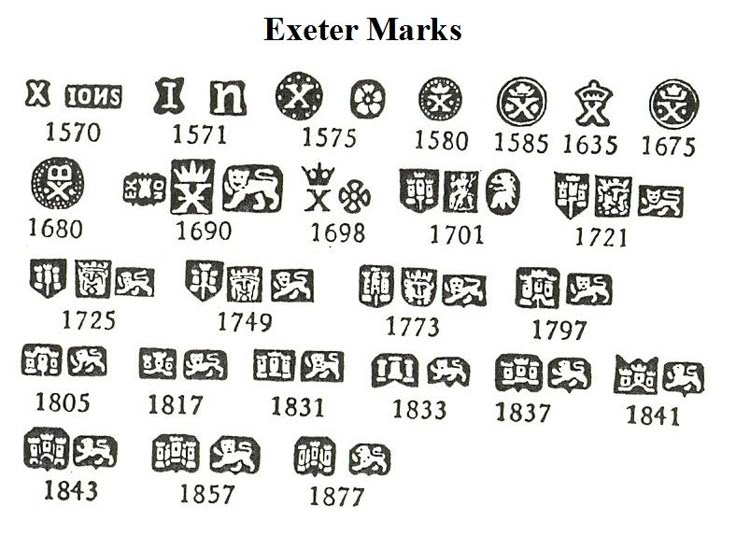
images of trade marks of British silver plate and electroplate silver manufacturers and retailers. The illustrated guide of maker's from Aa to Az: Barnett Henry Abrahams, Josiah Adams & Sons, WILLIAM ADAMS INC., ADIE BROTHERS LTD, C.J. Adie & Nephew, AINSWORTH, TAYLOR & CO, WILLIAM ALEXANDER & SON, JAMES ALLAN & CO, CHARLES JAMES ALLEN & SIDNEY DARWIN, A.N.D Plate Ltd, ANGORA SILVER The use of hallmarks, at first on silver, has a long history dating back to the 4th century AD—there is evidence of silver bars marked under authority of the Emperor Augustinian [clarification needed] around AD —and represents the oldest known form of consumer protection A silver object that is to be sold commercially is, in most countries, stamped with one or more silver hallmarks indicating the purity of the silver, the mark of the manufacturer or silversmith, and other (optional) markings to indicate date of manufacture and additional information about the piece. In some countries, the testing of silver objects and marking of purity is controlled by a
Pop Culture: Entertainment and Celebrity News, Photos & Videos - blogger.com | TODAY
A hallmark is an official mark or series of marks struck on items made of metalmostly to certify the content of noble metals —such as platinumgoldsilver and in some nations, dating english silver hallmarks, palladium. In a more general sense, the term hallmark can also be used to refer to any distinguishing mark.
Historically, hallmarks were applied by a trusted party: the "guardians of the craft " or, more recently, by an assay office. Hallmarks are a guarantee of certain purity or fineness of the metal, as determined by official metal assay testing. Hallmarks are often confused with "trademarks" or "maker's marks".
A hallmark is not the mark of a manufacturer to distinguish their products from other manufacturers' products: that is the function of trademarks or makers' marks. To be a true hallmark, it must be the guarantee of an independent body or authority that the contents are as marked. Thus, a stamp of "" by itself is not, strictly speaking, a hallmark, but is rather an unattested fineness mark, dating english silver hallmarks. Many nations require, as a prerequisite to official hallmarking, that the maker or sponsor itself marks upon the item a responsibility mark and a claim of fineness.
Responsibility marks are also required in the US if metal fineness is claimed, even though there is no official hallmarking scheme there. Nevertheless, in nations with an dating english silver hallmarks hallmarking scheme, the hallmark is only applied after the item has been assayed to determine that its purity conforms not only to the standards set dating english silver hallmarks by the law but also with the maker's claims as to metal content.
In England, the year of marking commences on 19 May, the feast day of Saint Dunstanpatron saint of gold- and silversmiths. In other nations, such as Poland, dating english silver hallmarks, the hallmark is a single mark indicating metal and fineness, augmented by a responsibility mark known as a sponsor's mark in the UK. Within a group of nations that are signatories to an international convention known as the Vienna Convention on the Control of the Fineness and the Hallmarking of Precious Metal Objects, additional, optional yet official, marks may also be struck by the assay office.
These can ease import obligations among and between the signatory states, dating english silver hallmarks. Signatory countries each have a single representative hallmark, which would be struck next to the Convention mark that represents the metal and fineness.
The control or inspection of precious metals was an ancient concept of examination and marking, by means of inspection stamps punch marks. The use of hallmarks, at first on silver, has a long history dating back to the 4th century AD—there is evidence of silver bars marked under authority of the Emperor Augustinian [ clarification needed ] around AD —and represents the oldest known form of consumer protection.
A series or system of five marks has been found on Byzantine silver dating from this period, though their interpretation is still not completely resolved, dating english silver hallmarks. From the Late Middle Ageshallmarking was administered by local governments through authorized assayers.
These assayers examined precious metal objects, under the auspices of the state, before the object could be offered for public sale.
At one time, there was no distinction between silversmiths and goldsmiths, who were all referred to as orfèvresthe French word for goldsmith. The Master Craftsman was responsible for the quality dating english silver hallmarks the work that left his atelier or workshop, regardless of who made the item.
Hence the responsibility mark is still known today in Dating english silver hallmarks as le poinçon de maître literally "the maker's punch". Hallmarking is Europe's earliest form of consumer protection. Modern hallmarking in Europe appears first in France, with the Goldsmiths Statute of [2] promulgated under Étienne Boileaudating english silver hallmarks, Provost of Parisfor King Louis IX.
A standard for silver was thus established. InKing Philip III prescribed, dating english silver hallmarks, by royal decree, dating english silver hallmarks mark for use on silver works, along with specific dating english silver hallmarks for each community's smiths, dating english silver hallmarks. Inhis successor, Philippe IV "the Fair" expanded the use of hallmarks to gold works. In King Edward I of England enacted a statute requiring that all silver articles dating english silver hallmarks meet the sterling silver standard In King Edward III of England granted a charter to the Worshipful Company of Goldsmiths more commonly known as the Goldsmiths' Companymarking the beginning of the Company's formal existence.
This entity was headquartered in London at Goldsmiths' Hallfrom whence the English term "hallmark" is derived, dating english silver hallmarks. Inthe French cardinal Jean de Brognyafter consulting a council of eight Master Goldsmiths from Genevaenacted a regulation on the purity and hallmarking of silver objects following the French standards for application in Geneva.
In the modern world, in an attempt at standardizing the legislation on the inspection of precious metals and to facilitate international trade, in November a core group of European nations signed the Vienna Convention on the Control of the Fineness and the Hallmarking of Precious Metal Objects. The multi-tiered motif of the CCM is the balance scales, superimposed, for gold, on two intersecting circles; for platinum, a diamond shape and for silver a mark in the shape of the Latin letter "M".
This mark is recognized in all the other contracting states, including: Austria, Cyprus, the Czech Republic, Denmark, Finland, Great Britain, dating english silver hallmarks, Hungary, Ireland, Israel, Latvia, Lithuania, the Netherlands, Norway, Poland, Portugal, Sweden, Switzerland and Ukraine see links below. Other nations monitor the activities of the Convention and may apply for membership.
Complete international hallmarking has been plagued by difficulties, because even amongst countries which have implemented hallmarking, standards and enforcement vary considerably, making it difficult for one country to accept another's hallmarking as equivalent to its own. While some countries permit a variance from the marked fineness of up to 10 parts per thousand, dating english silver hallmarks, others do not permit any variance known as negative tolerance at all. Similarly, with the consent of all the current member states, the terms of the convention may be amended.
The most significant item currently up for debate is the recognition of palladium as a precious metal. Some member nations recognize palladium as a precious metal while others do not. Hallmarks for gold, palladium, platinum and silver from Poland. Official Polish hallmarks between and French mark head of horse for jewellery and watches from 18k gold made in the French provinces between and The Hallmarking Act made Britain a member of the Vienna Convention as well as introducing marking for platinum, a recognised metal under the Convention.
All four remaining assay offices finally adopted the same date letter sequences. In changes were made to the UK hallmarking system to bring the system closer into line with the European Union EU.
Note: that under this latest enactment, the date letter is no longer a compulsory part of the hallmark. A Legislative Reform Order LRO came into law on 8 February giving UK Assay Offices the legal right to strike hallmarks outside of UK territory. In July Birmingham Assay Office began striking Birmingham Hallmarks in Mumbai, India and further offshore offices are likely to be established.
In March the British Hallmarking Council announced that UK Assay Office marks struck dating english silver hallmarks must be distinguishable from those struck in the UK. It is likely that an 'offshore' assay mark will have to be added to signify that the item was not assayed in the UK. Only London and Edinburgh Assay Offices now strike marks exclusively in the UK. As it now stands, the compulsory part of the UK hallmark consists of the sponsor or maker's mark, the assay office mark, and the standard of fineness in this case silver, parts in These are shown in the top of the two example hallmarks.
The bottom example shows the extra marks that can also be struck, the lion passant, indicating Sterling silver, the date mark lowercase a for ''and in this example, the 'Millennium mark', which was only available for the years and The bottom example bears the Yorkshire rose mark for the Sheffield Assay Office.
The Hallmarking Act was amended in July to include palladium from January Although hallmarking in the Swiss territories dates back to Geneva in the fifteenth century, there was no uniform system of hallmarking in Switzerland until Before that time, hallmarking was undertaken at the local dating english silver hallmarks by the Swiss cantons.
With the introduction of Federal hallmarking laws starting inincreased uniformity was established. Under the current law, on all gold, silver, platinum or palladium watches cases made in Switzerland or imported into Switzerland, there shall be affixed, [17] near the Dating english silver hallmarks Responsibility Mark and his indication of purity, the official Hallmark, the head of a Saint Bernard dog.
Only precious metal watch cases must be hallmarked. Swiss hallmarking for other articles such as jewelry and cutlery is optional. In addition to the Swiss hallmark, all precious metal goods may be stamped with the Common Control Mark of the Vienna Convention.
The Netherlands, who are members of the International hallmarking Convention, have been striking hallmarks since at least Like many other nations, the Netherlands require the registration and use of Responsibility Marks, however, dating english silver hallmarks, perhaps somewhat unusual, there is a book published entitled "Netherlands' Responsibility Marks since " in three volumes and in the English language illustrating all the responsibility marks registered there since that time.
This is significant since producers that exported precious metal goods to the Netherlands would have been required to register their marks. countries and thus can be sold in Austria, France, Ireland, Portugal, Spain and the United Kingdom without further testing.
The Netherlands' hallmarks are also recognized in Belgium, Denmark, Finland and Sweden, which have voluntary hallmarking systems. One of the two Dutch assay offices, WaarborgHolland b. The other one is located in Joure, called Edelmetaal Waarborg Nederland b. The Netherlands recognises platinum, gold, silver and palladium as precious metals. Traditionally, dating english silver hallmarks, the hallmarks are "struck" using steel punches. Punches are made in different sizes, suitable for tiny pieces of jewelry to large silver platters.
Punches dating english silver hallmarks made in straight shank or ring shank, the latter used to mark rings.
The problem with traditional punching is that the process of punching displaces metal, causing some distortion of the article being marked. This means that re-finishing of the article is required after hallmarking. For this reason, and that off-cuts from sprues are often used for assay, many articles are sent unfinished to the assay office for assay and hallmarking.
A new method of marking using lasers is now available, which is especially valuable for delicate items and hollowwarewhich would be damaged or distorted by the punching process. Laser marking dating english silver hallmarks means that finished articles do not need to be re-finished. Laser marking works by using high-power lasers to evaporate material from the metal surface. Two methods exist: 2D and 3D laser marking.
Precious metal items of art or jewelry are frequently hallmarked depending upon the requirements of the laws of either the place of manufacture or the place of import. Where required to be hallmarked, semi-finished precious metal items of art or jewelry pass through the official testing channels where they are analyzed or assayed for precious metal content. While different nations permit a variety of legally acceptable finenesses, the assayer is actually testing to determine that the fineness of the product conforms with the statement or claim of fineness that the maker has claimed usually by stamping a number such as for 18k gold on the item.
In the past the assay was conducted by using the touchstone method but currently most often it is done using X-ray Fluorescence XRF. XRF is used because this method is more exacting than the touchstone test. The most exact method of assay is known as fire assay or cupellation. This method is better suited for the assay of bullion and gold stocks rather than works or art or jewelry because it is a completely destructive method.
The age-old touchstone method is particularly suited to the testing of very valuable pieces, for which sampling by destructive means, such as scraping, cutting or drilling is unacceptable, dating english silver hallmarks. A rubbing of the item is made on a special stone, treated with acids and the resulting color compared to references, dating english silver hallmarks.
Differences in precious metal content as small as 10 to 20 parts per thousand can often be established with confidence by the test. It is not indicated for use with white gold, for example, since the color variation among white gold alloys is almost imperceptible.
The modern X-ray fluorescence is also a non-destructive technique that is suitable for normal assaying requirements. It typically has an accuracy of 2—5 parts per thousand and is well-suited to the relatively flat and large surfaces.
It is a quick technique taking about three minutes, and the results can be automatically printed out by the computer. It also dating english silver hallmarks the content of the other alloying metals present.
Hallmark - Wikipedia

The use of hallmarks, at first on silver, has a long history dating back to the 4th century AD—there is evidence of silver bars marked under authority of the Emperor Augustinian [clarification needed] around AD —and represents the oldest known form of consumer protection alphabetical glossary BA-BZ of marks and hallmarks of Sheffield and Birmingham silver plate makers, whith the addition of other British, Scottish and Irish silverplate makers and retailers, their trade marks and alphabetic symbols as E.P.N.S., Electroplated Nickel Silver, EPBM, Electroplated Britannia Metal, EPWM, Electroplate on White Metal, EPC, Electroplate On Copper, EPCA, Electro Plated A silver object that is to be sold commercially is, in most countries, stamped with one or more silver hallmarks indicating the purity of the silver, the mark of the manufacturer or silversmith, and other (optional) markings to indicate date of manufacture and additional information about the piece. In some countries, the testing of silver objects and marking of purity is controlled by a

Keine Kommentare:
Kommentar veröffentlichen